Resurrecting the Legend: How Callan Brown Found the 1974 Wild Gunman
Callan Brown discovered rare film reels on eBay for Nintendo's legendary 1974 arcade cabinet Wild Gunman, thought lost forever. After extensive restoration work, he successfully reconstructed a working machine, a key artifact in video game history.
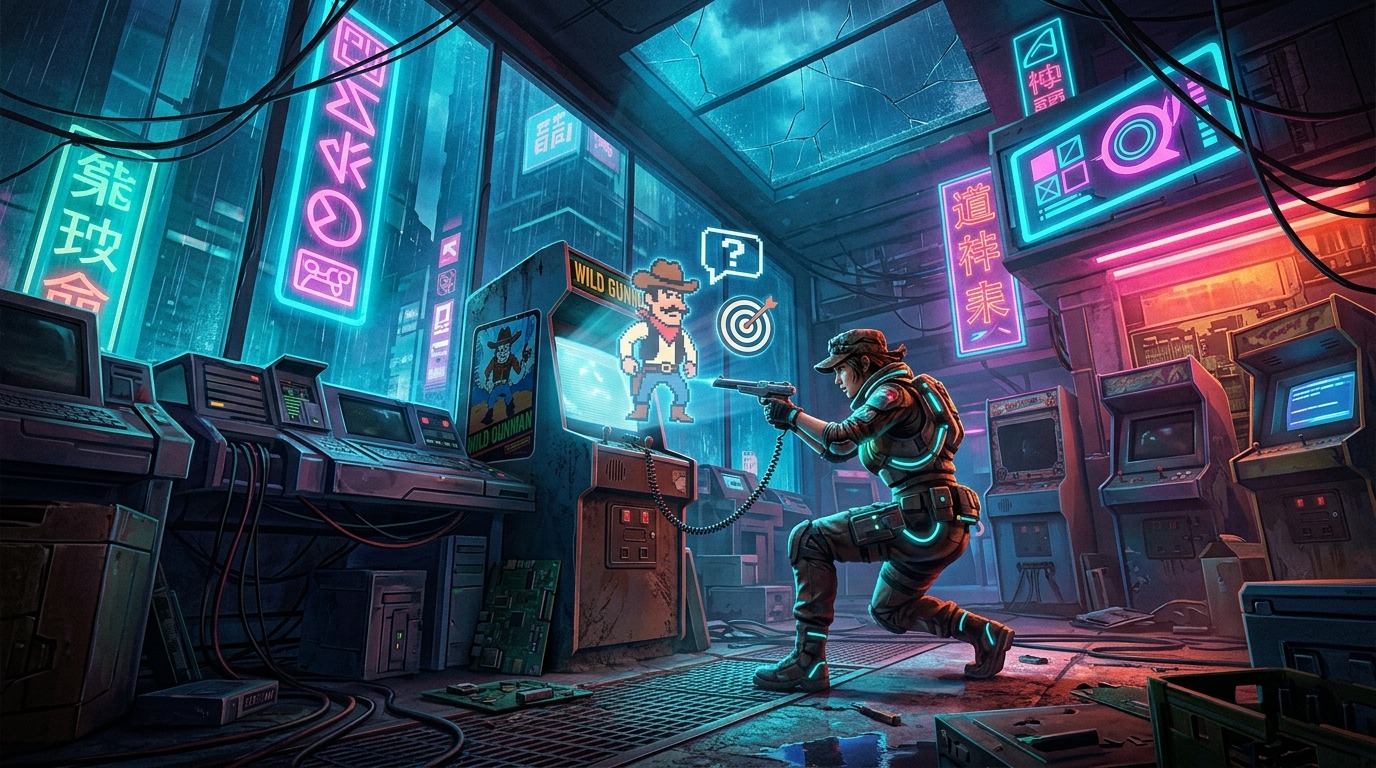
Resurrecting the Legend: How Callan Brown Found the 1974 Wild Gunman. Imagine an era where video games were not rendered by GPUs, but brought to life by... actual film stock. Long before Nintendo revolutionized the industry with the NES and Switch, the company took ambitious steps into the arcade entertainment sector. In 1974, Wild Gunman hit the market – a machine that defies modern definitions of "video games." It was an electromechanical device powered by a specialized 16 mm projection system that reacted in fractions of a second to the player's aim against animated outlaws. Pure analog engineering magic that surprisingly outpaced its era.
| Title | Wild Gunman |
| Genre | Electromechanical Light Gun |
| Developer | Nintendo |
| Designer | Gunpei Yokoi |
| Publisher | Nintendo |
| Release Date | 1974 |
| Platform | Electromechanical arcade cabinet |
| Cover Image | Nintendo |
Key Takeaways:
- Callan Brown discovered rare film reels on eBay for Nintendo's 1974 arcade cabinet Wild Gunman.
- The machine was powered by 16mm film stock, representing a breakthrough in pre-console era gaming.
- The restoration required a blend of historical knowledge and modern technology.
- The reconstructed Wild Gunman is likely the only fully operational unit in existence.
A Lost Treasure in the eBay Depths
For decades, gaming historians and archivists were convinced that original reels and fully functional cabinets had been lost forever, surviving only as footnotes in corporate manuals. That changed in late 2023. Callan Brown, a Canadian arcade restorer and prominent online creator, stumbled upon an online auction that initially looked like a system glitch. Purchasing film reels bearing the distinct, albeit slightly faded, Nintendo logo became a watershed moment in the field of digital preservation.
While browsing archival arcade parts on eBay, I came across a listing that made absolutely no sense: a set of original film reels with Nintendo branding. I knew if I didn't act quickly, the physical evidence of that era could vanish into history forever.
Digital precision from analog dust
Reviving Wild Gunman was far from a simple DIY weekend project. It was a grueling, months-long engineering marathon requiring synergy between retro hardware and modern software. Brown had to reverse-engineer expired Nintendo patents that had lain dormant in corporate archives for decades. The biggest technical hurdle was synchronizing analog film footage with light-gun control logic. Originally relying on photocells, relays, and mechanical gates, Brown integrated open-source software and modern microcontrollers to precisely read frame timing and replicate game reactions with millisecond accuracy.
Digital preservation was the mission's core. Every film sequence was scanned in high resolution, creating a digital backup that shields this heritage from further chemical decay. Today, Brown's cabinet is arguably the only fully operational, playable Wild Gunman in existence. It's more than a machine; it's tangible proof that passion and engineering determination can reverse the tide of digital obsolescence. Brown plans to showcase the restored unit at premier events like the Ontario PinFest, allowing new generations to experience the raw, mechanical thrill of the pre-console era.
This restoration also sheds new light on Nintendo's corporate evolution. Today, we associate the brand with Mario and Zelda, but for decades it manufactured hanafuda cards, mechanical toys, and exactly these types of electromechanical arcades. Wild Gunman represents a crucial link in that chain – the direct precursor to the Laser Clay Shooting System series, which cemented Nintendo's dominance in Asia and paved the way for its global video game conquest.
The Vision of Gunpei Yokoi
Behind this groundbreaking project stood none other than the legendary Gunpei Yokoi, father of the Game Boy and architect of the "Lateral Thinking with Withered Technology" philosophy. Yokoi was famous for squeezing maximum potential out of mature, often outdated components. For Wild Gunman, he utilized Tetoron (polyester) film stock, believing its mechanical durability could withstand thousands of playthroughs in Japanese arcades. However, intense commercial use proved unforgiving; the reels degraded over time, and the film eventually snapped under the stress of rapid mechanical projection.
When the late 70s and early 80s brought LaserDisc arcade cabinets (like Dragon's Lair) and fully electronic PCB boards, film-based machines were mass-scrapped. Brown refused to let history fade. After securing the reels, he sourced a functional classroom-grade projector to verify their contents. When the original Nintendo markings and outlaw sequences flashed on screen, it became undeniable: he had found an industry Holy Grail. These were not mere archival reels; they were the physical heart of one of the first interactive entertainment systems, silent for nearly half a century.
Wild Gunman's Technological Revolution
Wild Gunman was a true revolutionary in its time. The film-based medium allowed for almost cinematic action sequences, which was unprecedented for games of that era. Players had to demonstrate quick reflexes and accuracy to progress through the sequences. Today, with games reaching unimaginable levels of graphics, Wild Gunman reminds us of the simplicity and innovation that were at the foundation of the entire industry.
Wild Gunman's Modern Significance
Modern games use advanced technologies, but Wild Gunman shows that a game doesn't have to be complex to be engaging. Brown proved that video game history is alive and that even the most forgotten titles can be brought back to life. Thanks to his work, new generations of players will be able to see and appreciate the true evolution of games.
Would you like to play an original 1970s arcade cabinet in your home? (Yes / No)
Wild Gunman Today
The reconstruction of Wild Gunman is not just the story of one arcade cabinet. It's a tale of passion and determination that allows the preservation of gaming heritage. Callan Brown shows that even the most forgotten titles can be brought back to life. His work inspires not only retro game enthusiasts but also younger creators to search for and discover hidden treasures from the past.
For today's players, Wild Gunman can be not only a historical curiosity but also an inspiration to think about how simple mechanics can create an engaging gameplay experience. Thanks to such discoveries, video game history remains alive and evolving.
FAQ
Was Wild Gunman a digital game?
Absolutely not. It was a masterpiece of electromechanics. The game relied on a projection system that triggered specific film sequences based on whether the player hit the target using a light gun equipped with a photocell.
Why were the original film reels so rare?
The 1974 film stock was highly susceptible to mechanical wear and chemical degradation. Nintendo never created digital backups, and most cabinets were scrapped in the 1980s, making the survival of the original reels a statistical miracle.
Who is responsible for the reconstruction?
The project's lead creator and initiator is Callan Brown, a Canadian arcade restoration expert and gaming history advocate. His work bridges advanced technical skills with a commitment to digital preservation.
Where can I see this machine in person?
Callan Brown regularly documents progress on social media and YouTube. The cabinet is periodically showcased at major retro-gaming events, with Ontario PinFest serving as one of its primary exhibition venues.
What significance does Wild Gunman hold for modern Nintendo?
It's a direct precursor to Nintendo's design philosophy. A mechanism reacting to physical movement and player accuracy, rather than raw computing power, later evolved into franchises like Wii Sports and Laboratory, proving that innovation often stems from hardware limitations.
Did Nintendo produce other electromechanical games?
Yes, prior to the console era, Nintendo experimented with several arcade devices, including EVR Race (horse racing using video tape) and the Ultra Machine series. However, Wild Gunman remains their most mechanically sophisticated project, successfully merging interactivity with visual storytelling.