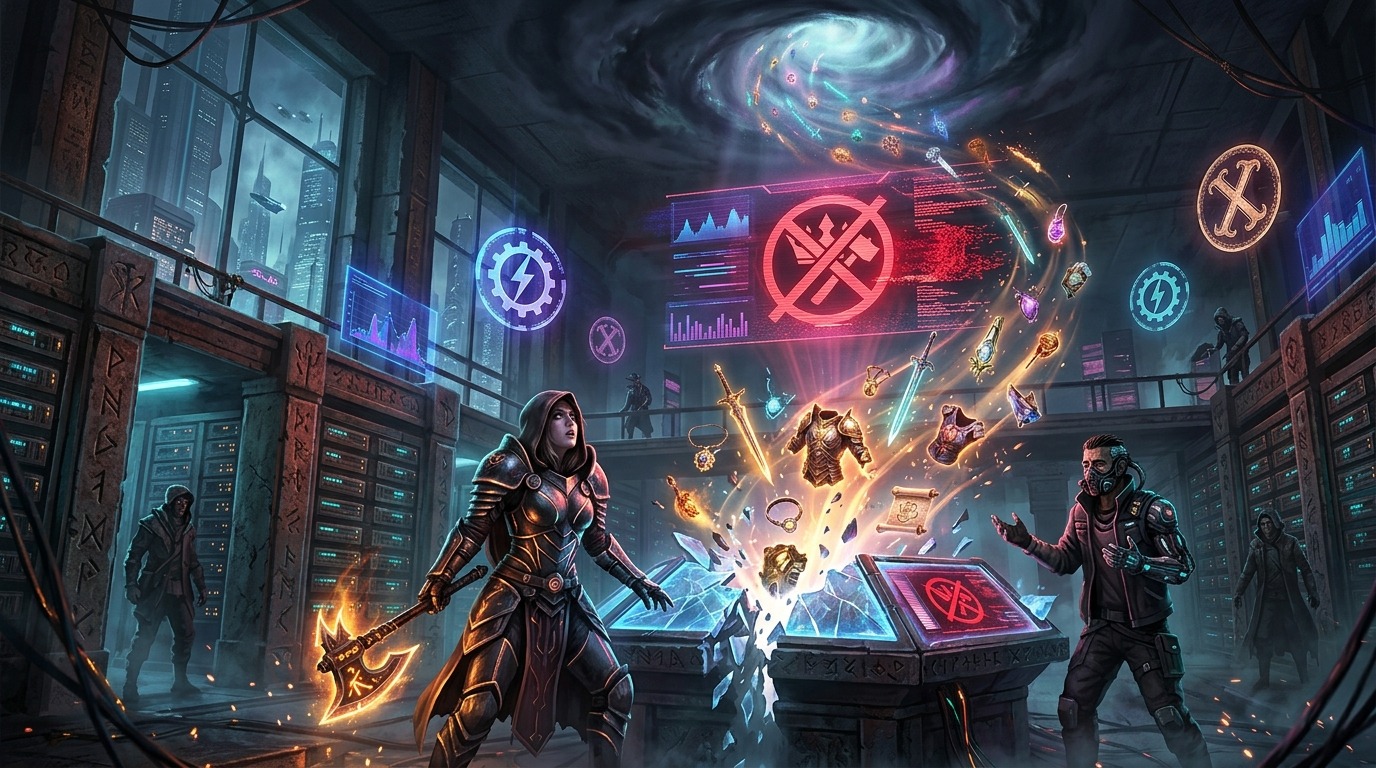
Path of Exile's Trading King Banned: Lost Treasures, Economic Shifts, and Unanswered Questions
Path of Exile's richest trader, The Forbidden Trove, has lost his account and over 1500 unique items forever. The community demands answers as GGG remains silent about the drastic crackdown.
The world of Path of Exile was rocked on the night of November 10-11, 2023. The most influential player, known as The Forbidden Trove, woke up to find his account completely wiped clean. All his possessions—over 1,500 items, including irreplaceable legacy uniques—had vanished into thin air. His public Reddit post, beginning with:
"This is the worst day of my life"— The Forbidden Trovesent shockwaves through the community.
| Title | Path of Exile |
|---|---|
| Genre | MMO Action RPG / Hack and Slash |
| Developer | Grinding Gear Games |
| Publisher | Grinding Gear Games |
| Release Date | October 23, 2013 (PC) |
| Platforms | PC, Xbox One, PlayStation 4 |
| Cover Image | Path of Exile |
Najważniejsze informacje w pigułce:
- The Forbidden Trove's account ban results in the permanent loss of over 1,500 unique items.
- GGG's silence fuels community unrest and fears of hyperinflation.
- Questions arise about the future of trading and whether this marks the end of PoE's 'wild' economy.
- The ban strikes at the heart of the game's player-driven economy, causing significant disruption.
Who was The Forbidden Trove?
The Forbidden Trove was no ordinary player. He was a living legend, the architect and de facto regulator of PoE's player-driven market. His name appeared in almost every major trade. He held virtual assets estimated in tens of thousands of exalts. His removal is not just a single ban—it's a strike at the very heart of the game's mechanics. Grinding Gear Games (GGG) makes a move that instantly reshapes the entire economy. What happens to the void left by such a player? Who takes control of the most precious items?
Why Now? Background on Economic Controversies
This incident is not isolated. In recent months, GGG has tightened its policies on real-money trading (RMT) and market manipulation. Patch 3.22 brought a wave of cleanups, but banning the “king of trade” is an entirely different matter. This is a clear signal: no one is untouchable. The studio's silence for over 48 hours only fuels the fire. In the information vacuum, theories multiply: Is this a genuine fight against RMT? Or an attempt to break up a cartel that the player himself built? Behind the scenes lies a long-standing debate about the influence of large players on the economy, and their activities – though controversial – had their place in the game's ecosystem.
The Lost Treasure: Legacy Uniques and Their Value
The greatest pain lies in irreversibility. Many of the 1,500+ items are legacy unique items from times before the Legacy League (2017) and other historical events. The game's mechanics simply don't allow them to be regenerated. It's like burning an original van Gogh painting and offering an IKEA print in return. The Forbidden Trove, in his post, emphasizes he's only asking for a restore of part of his collection, not full account unbanning. But even that is incredibly difficult. GGG's systems are built on finality. Once deleted, data is deleted.
Community Divided: Justice or Terror?
Reactions in the comments are polarized. Some shout: “Finally! He was a cartel!” Others: “This is a crime scale against a player who gave them millions of gameplay hours.” This split is dangerous. On one hand, Path of Exile's economy has always been wild, but that's precisely why it worked. The Forbidden Trove constantly stabilized prices, provided liquidity. His sudden disappearance could cause hyperinflation on key items. On the other, if he truly broke the rules (and such a ban rarely happens without cause), then every player should be equal before the rules. But equality in the studio's eyes is a uniform silver bullet: all banned are equal, even if they lose decades of in-game life. This is the deeply human side of the debate.
Lessons from EVE Online and Other Ban Cases in Gaming History
The story recalls the famous EVE Online incident from 2007, when CCP Games (EVE's creators) wiped billions of ISK (EVE's currency) from players' accounts exploiting a bug. Chaos and accusations of overly harsh penalties were there too. But CCP then issued a long, detailed post explaining every step. GGG's silence is louder. Is it unprepared for the scale? Or deliberate? Maybe they want anger to first target the banned player before they announce an official stance? That's a risky strategy. In live-service games, trust is the most valuable currency. And it's melting away. Other cases, such as controversies surrounding Diablo Immortal or communication blunders in World of Warcraft, show that trust issues have long-lasting effects.
What's Next for Trading? Return to Barter?
If The Forbidden Trove was indeed the main liquidity hub, the market might freeze. Players will stop trusting medium and large trades. Paranoid “trade at your own risk” will return. New, smaller hubs will emerge. Or maybe a return to direct barter? A backward evolution. That's the perfect scenario for GGG, which for years dreamed of limiting economy complexity. But do they really want such a change at the cost of their most loyal players? That question remains unanswered until the studio breaks its silence.
The Hardest Test for GGG: Communicating with Fans
This incident is a stress test for GGG's philosophy. The studio for years built an image of “play fair, even if it hurts.” But here the pain isn't hitting an abstract principle—it's hitting a specific human with a specific history. Will they hold the line? Will they find a compromise? Do they even understand the scale of destruction? Silence is not an option. Every day without communication is another wave of negative leaks, another lost heart of players who supported the game for years. It's no longer about items. It's about whether Path of Exile remains a place where loyalty has any value at all.
History and Evolution of Economy in Path of Exile
Since the beginning of Path of Exile, the economy has been its heart. The early years, from its premiere in 2013, were characterized by wild inflation and experiments with the currency system. The introduction of chaos orbs, exalt orbs, and later fated and divine orbs, aimed to balance the economy. With subsequent seasonal leagues, new economic mechanics appeared – from trading map cards to introducing crafting. History shows that GGG has always strived for control over the economy, but never before have there been such drastic actions. This is a new chapter in the history of this game.
Game Systems and Hardware Requirements
Path of Exile, while not the most modern game in terms of graphics, requires a certain computing power from hardware. Minimum requirements are an Intel Core i3 processor, 4 GB of RAM, and an NVIDIA GeForce GTX 650 Ti graphics card. For smooth gameplay, higher specifications are recommended. The game offers many graphics settings, allowing you to adjust its appearance to suit your hardware capabilities. It's also worth noting the optimization, which has significantly improved in recent years.
What's Next for Trading? The Future of PoE
The market faces uncertainty. The disappearance of such a large player risks hyperinflation and a return to distrustful, direct barter trading. Could we see a return to direct barter? It's a backward evolution, but perhaps that's exactly what GGG wanted to achieve by limiting the complexity of the economy. The question is, is it worth doing at the expense of the most dedicated players?
The Hardest Test for GGG
This incident is a stress test for GGG's philosophy. The studio for years built an image of “play fair, even if it hurts.” But here the pain isn't hitting an abstract principle—it's hitting a specific human with a specific history. Will they hold the line? Will they find a compromise? Do they even understand the scale of destruction? Silence is not an option. Every day without communication is another wave of negative leaks, another lost heart of players who supported the game for years. It's no longer about items. It's about whether Path of Exile remains a place where loyalty has any value at all.
FAQ
Why was The Forbidden Trove banned?
GGG has not yet issued an official statement. The community speculates the ban may have resulted from a violation of rules regarding real-money trading (RMT) or market manipulation, which aligns with the studio's recent policy tightening.
Can the lost items be restored?
Highly unlikely. GGG's systems are designed for finality. Many of the 1500+ items are unique legacy items from old leagues that physically cannot be recreated in-game. The Forbidden Trove asked only for a partial restore of his collection, but even that is extremely difficult.
How will the ban affect the game's economy?
It may severely disrupt market liquidity. The Forbidden Trove was a key liquidity hub and price stabilizer. His sudden disappearance could lead to panic, hyperinflation on certain items, and a return to distrustful, direct barter trading.
Should GGG communicate more with the community?
Yes. The studio's silence for over 48 hours after such a drastic event deepens the crisis of trust. In live-service games, transparency and swift response are crucial for maintaining community faith in the system's fairness.
Does this mean the end of PoE's 'wild' economy?
It might. Banning one of the most powerful player-market rulers could be a conscious move by GGG towards greater control and economic simplification—something the studio has desired for years. However, doing so at the cost of its most loyal players is a very risky and controversial strategy.